
Your Company Brain
Your Company Brain shouldn't start empty.
Second Brain Link bootstraps institutional memory from the exports you already have — LinkedIn Company, Google Workspace, Slack, CRM — into a structured, deduplicated, privacy-clean Company Brain your agents can use on day one. Emit to GBrain, or keep it in Obsidian for the team. Runs locally; employee PII is stripped in code.
building for yourself? Your personal brain →
LinkedIn Company · Workspace · Slack · CRM → one Company Brain
Second Brain Studio
Browse and talk to your Company Brain — right in the browser.
No setup, no plugins. Open your Company Brain in a live workspace: explore how teams, people, and accounts connect, read notes, and ask an AI that reasons over the whole graph. Runs locally — your keys and data stay on your machines.
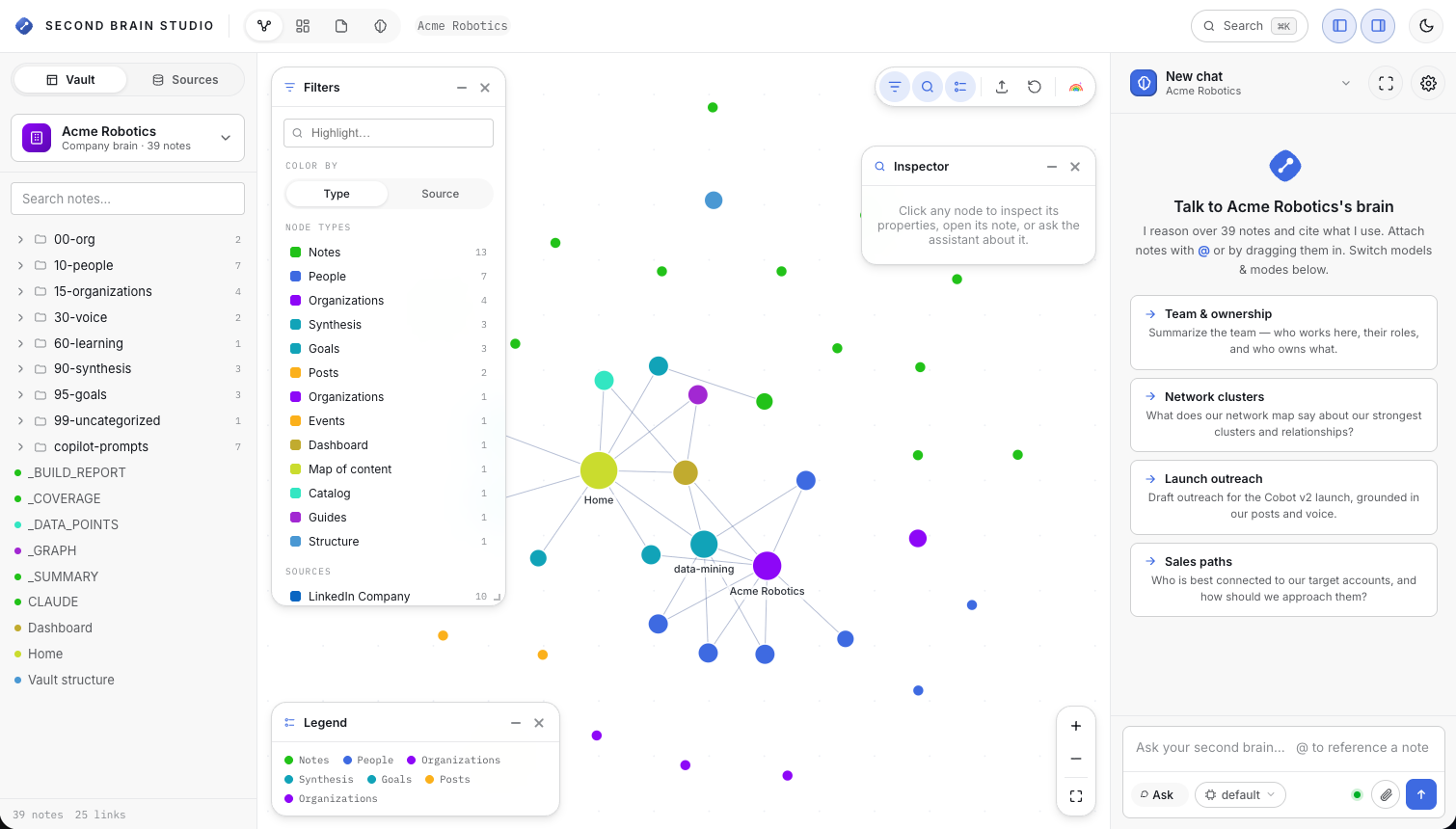
Interactive graph
A live, force-directed graph of every employee, team, customer and deal. Filter by type or source, search, and click any node to open its note.
Talk to your brain
A built-in assistant — Claude, OpenAI, Gemini and more — that cites the notes it used. Bring your own key; calls go straight to the provider. Nothing leaves your infrastructure.
Read, edit & track
A full Markdown editor with live preview, wikilinks and backlinks, plus a computed dashboard of your network and clusters.
The problem
The brain is the easy part now. Filling it isn't.
A new Company Brain is empty on day one, and your institutional knowledge is trapped in exports, shared drives, and old accounts. New hires re-learn what the company already knew. When someone leaves, the context leaves with them.
exports/
├── workspace-export.zip       contacts, drive, 4.2 GB
├── slack-export.zip           channels.json, users.json
├── crm-accounts.csv           1,860 rows, stale owners
└── linkedin-company.zip       followers, employees

✕ four silos · same employee 4× · zero links
brain/
├── 00-org/company.md          org-rooted graph
├── 10-people/
│   └── Dana-Reyes.md          1 person · 4 sources
├── 20-accounts/
│   └── Northwind-Co.md        owner, history, stage
├── 40-projects/
└── _correlations/             people ↔ deals ↔ teams

✓ populated, deduplicated, privacy-clean — day one
Institutional memory that survives turnover — the context stays when people move on.
How it works
Point it at your exports. Get a connected Company Brain.
- 01
Detect
Point it at a folder of team exports — Workspace, Slack, CRM, LinkedIn Company. It catalogs every file, locally.
- 02
Resolve
Every employee, customer, and partner becomes one identity across sources — no more four copies of Dana.
- 03
Build
An org-rooted graph: the company at the center; people, accounts, deals, and projects linked around it. No AI calls.
- 04
Emit
Emit to GBrain for the team, or keep it as an Obsidian vault. Multiple entities get a cross-entity
_correlations/brain.
Agent-ready
Institutional memory, as structured data.
Org-rooted graph
The company sits at the center — 00-org — with employees, accounts, deals, and projects as typed, linked notes around it.
Ownership is explicit
Every account knows its owner and backup. "Who has the relationship?" is a graph query, not tribal knowledge.
Cross-entity correlations
Multiple teams or entities each get a brain, plus a _correlations/ layer linking people ↔ deals ↔ teams across them.
Day-one agent context
Ships with in-brain instructions — point Claude Code or GBrain at it and it knows the schema immediately.
Works with GBrain
Bootstrap your GBrain Company Brain from data you already have.
GBrain is the brain layer — search, synthesis, team serving. We're the importer that fills it on day one, from your fragmented exports, identity-resolved and privacy-clean.
Not affiliated with the GBrain project. We emit the open-source GBrain format — we're the importer; GBrain is the brain.
Privacy-first
Your team's data never has to leave your machines.
The whole import runs locally before anything reaches a server or a shared brain — you stay the data controller throughout.
Employee PII never written
Emails and phone numbers are stripped in code at parse time — they never reach disk.
Bodies never read
Slack and mail content is never parsed. Only a frequency and recency signal survives.
HR · payroll · security quarantined
Sensitive exports are skipped by a hard-coded quarantine list — no adapter can bypass it.
You stay the data controller
Everything runs on your infrastructure before anything reaches a server. MIT-licensed — your security team can read every line.
Local-first by construction. → Read the privacy model
What your brain can do
Give your company's brain a goal.
Get started
Bootstrap your Company Brain.
Prefer we do it?
Hand us your exports. Get back a populated brain.
We can onboard your company's brain for you — import, resolve, privacy-clean, and hand it back in GBrain or Obsidian. (Early access.)
Local-first · MIT · you're the data controller · emits to GBrain.