
The context layer for your AI
Rent the model.
Own the memory.
Intelligence became a commodity. Context didn’t. Everyone runs the same models, cheaper every quarter — your decade of history is the input nobody else has. Second Brain Link turns the exports you already own into a brain for your agents: local, deterministic, plain Markdown, MIT.
building for yourself? Your personal brain →
LinkedIn Company · Workspace · Slack · Notion · Jira · CRM · 12 sources → one Company Brain
Second Brain Studio
See your Company Brain. Then just ask.
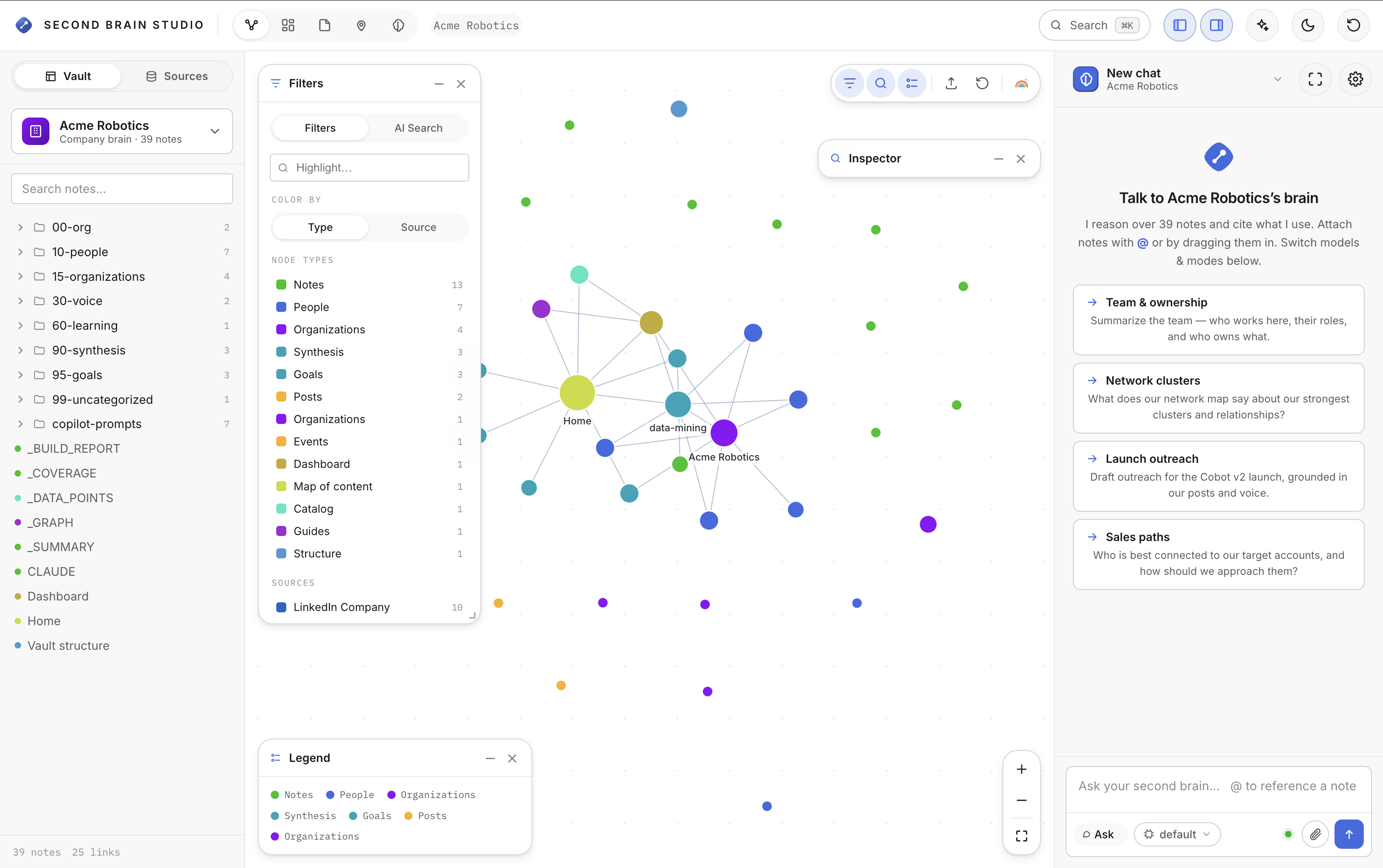
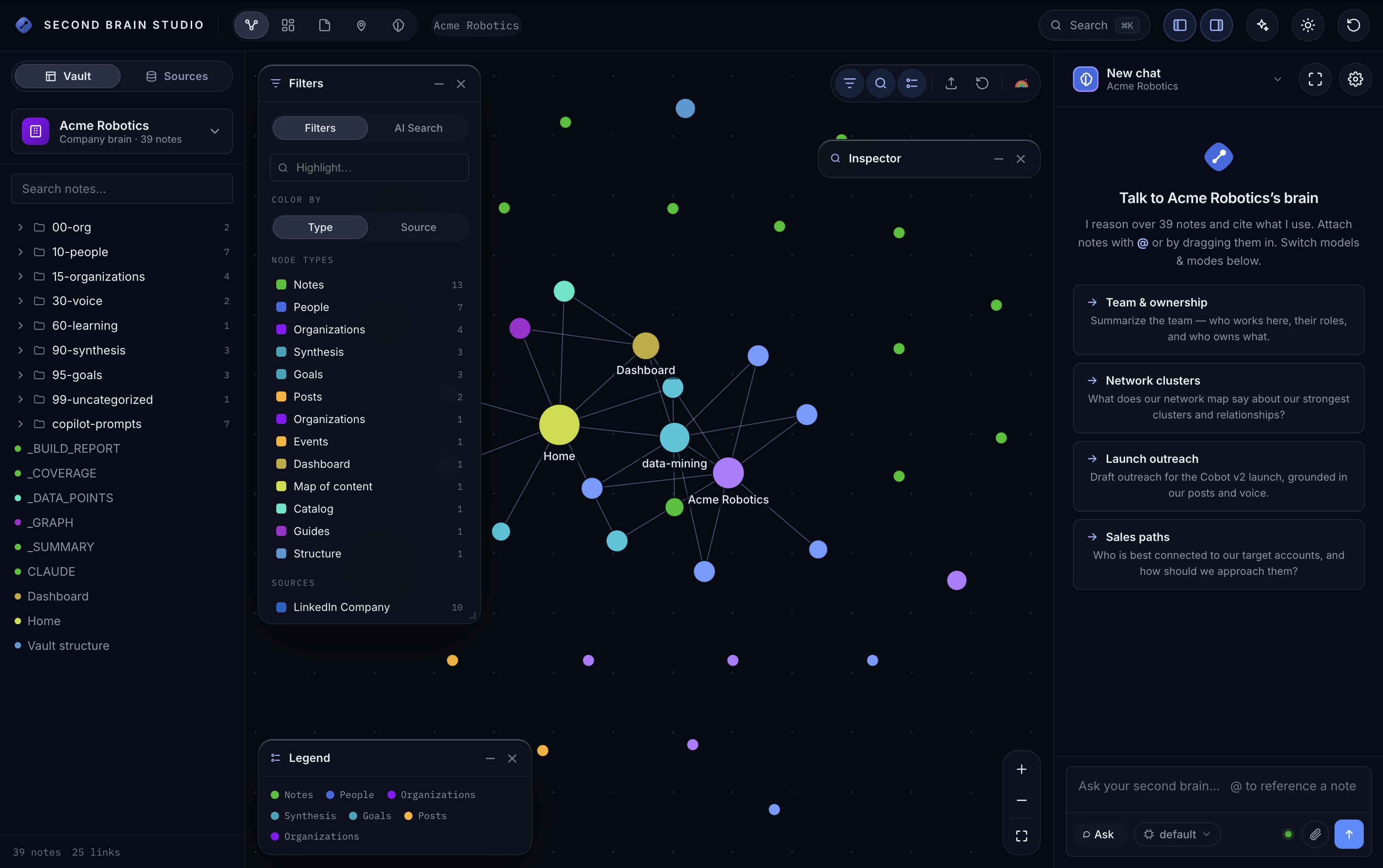
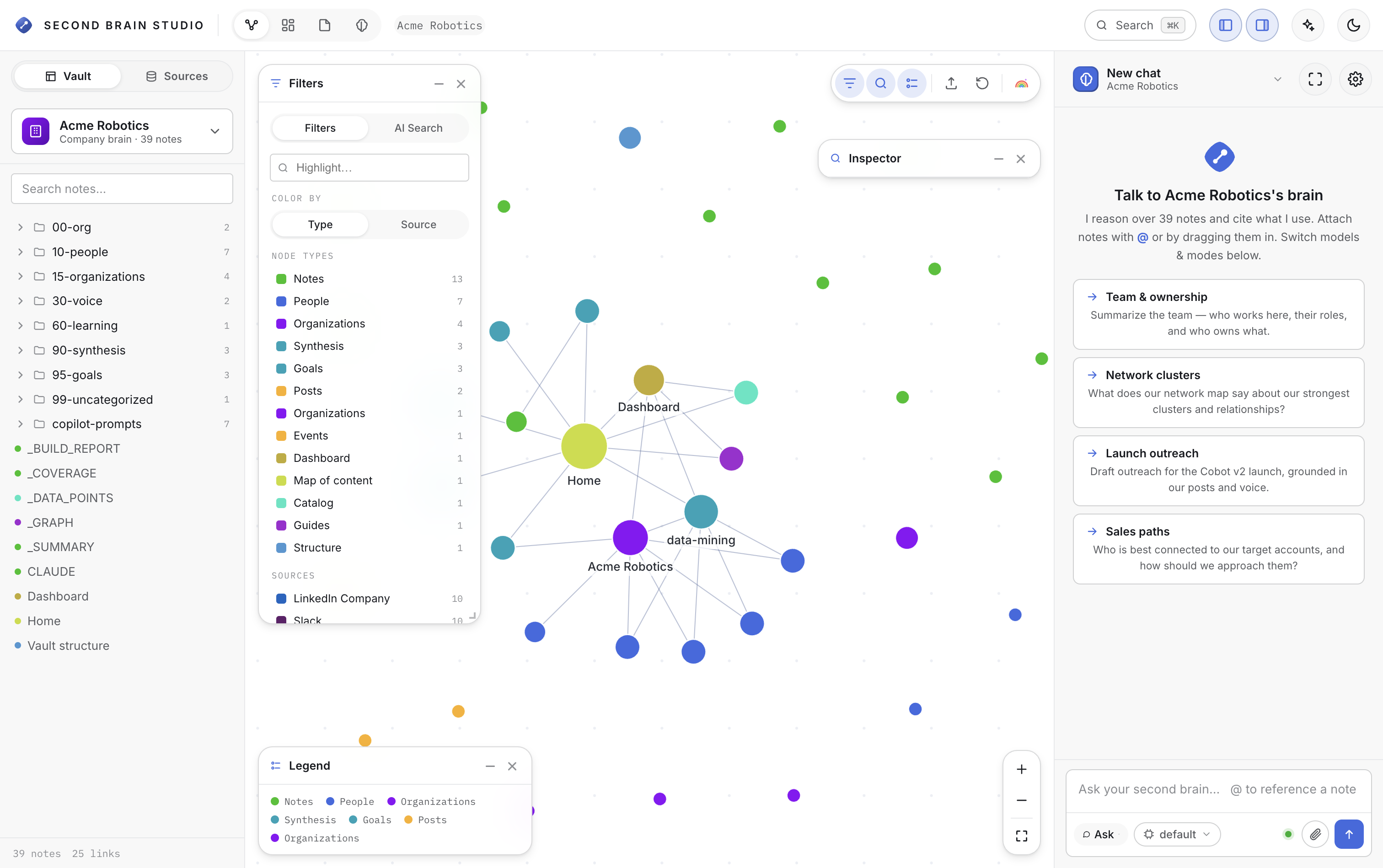
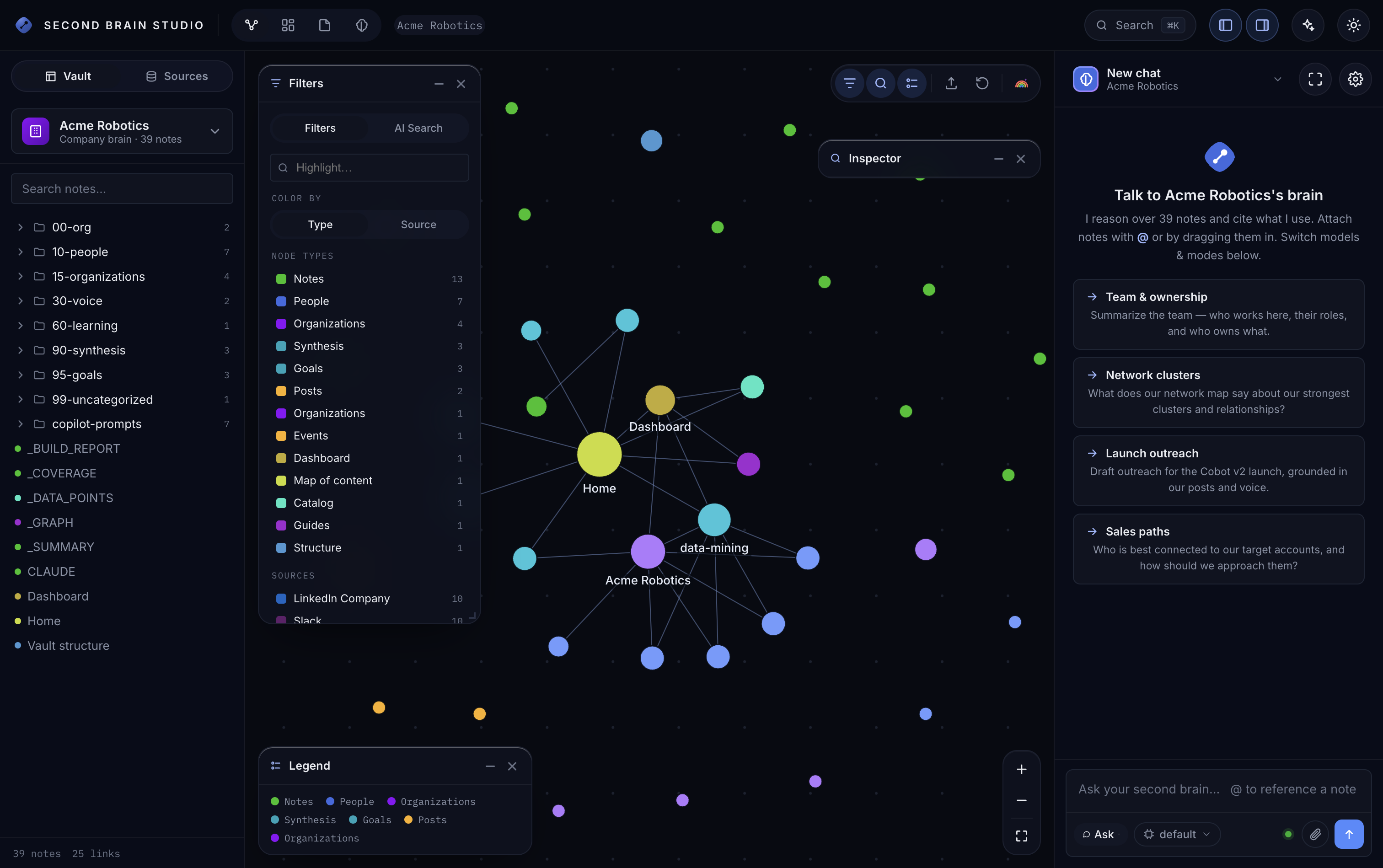
No setup, no plugins. Open your Company Brain in a live workspace: explore how teams, people, and accounts connect, read notes, and ask an AI that reasons over the whole graph. Runs locally — your keys and data stay on your machines.
Interactive graph
A live, force-directed graph of every employee, team, customer and deal. Filter by type or source, search, and click any node to open its note.
Talk to your brain
A built-in assistant — Claude, OpenAI, Gemini and more — that cites the notes it used. Bring your own key; calls go straight to the provider. Nothing leaves your infrastructure.
Read, edit & track
A full Markdown editor with live preview, wikilinks and backlinks, plus a computed dashboard of your network and clusters.
Second Brain Mobile · iOS & Android
It builds on the phone. Nothing reaches your infrastructure.
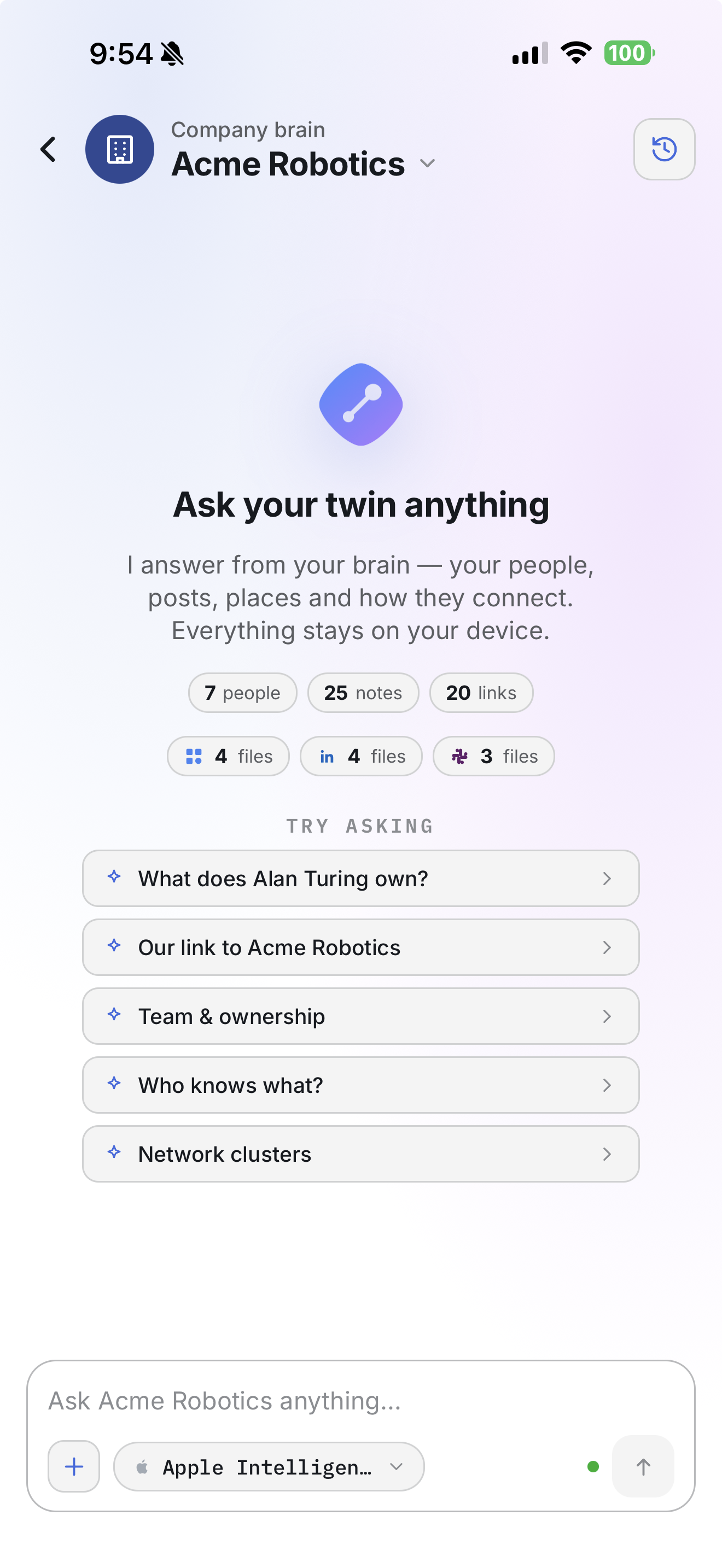
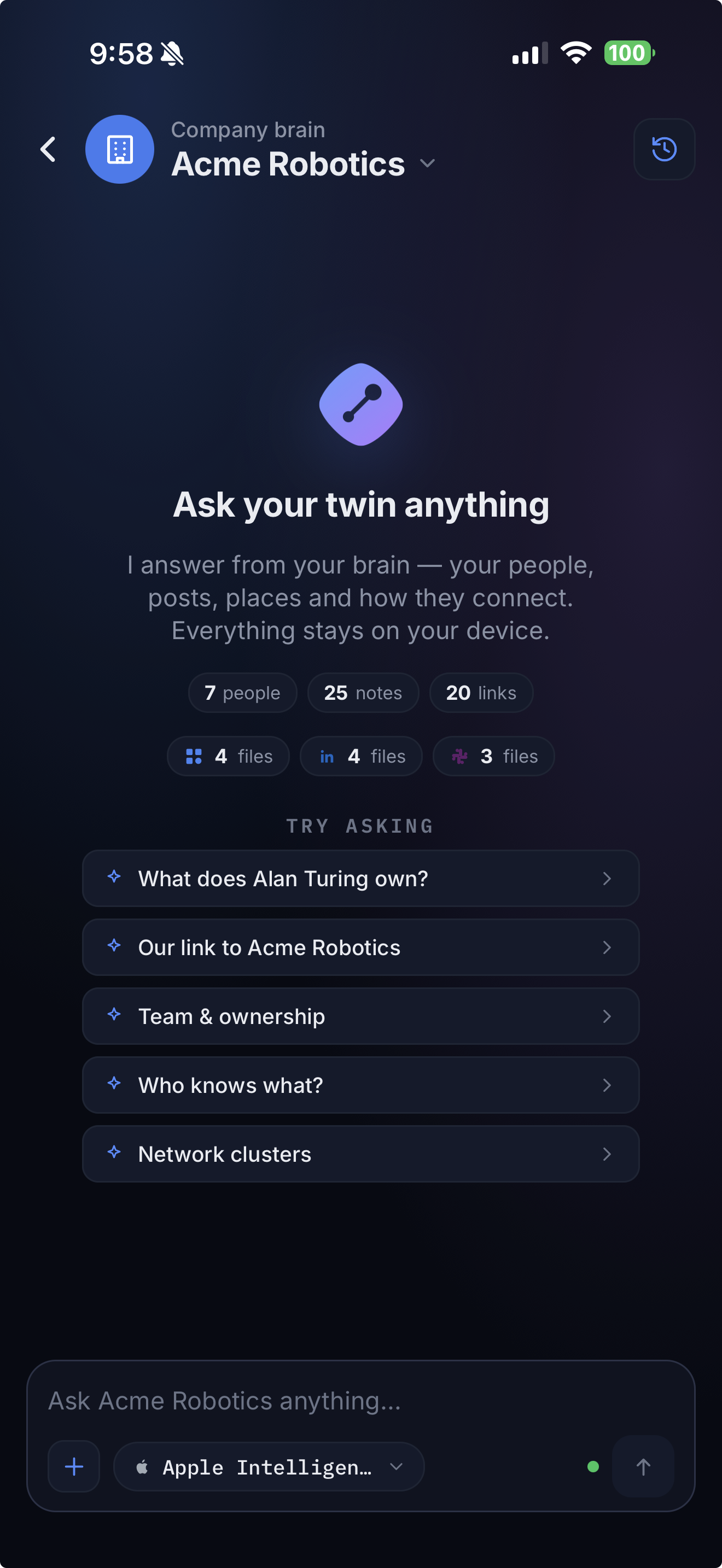
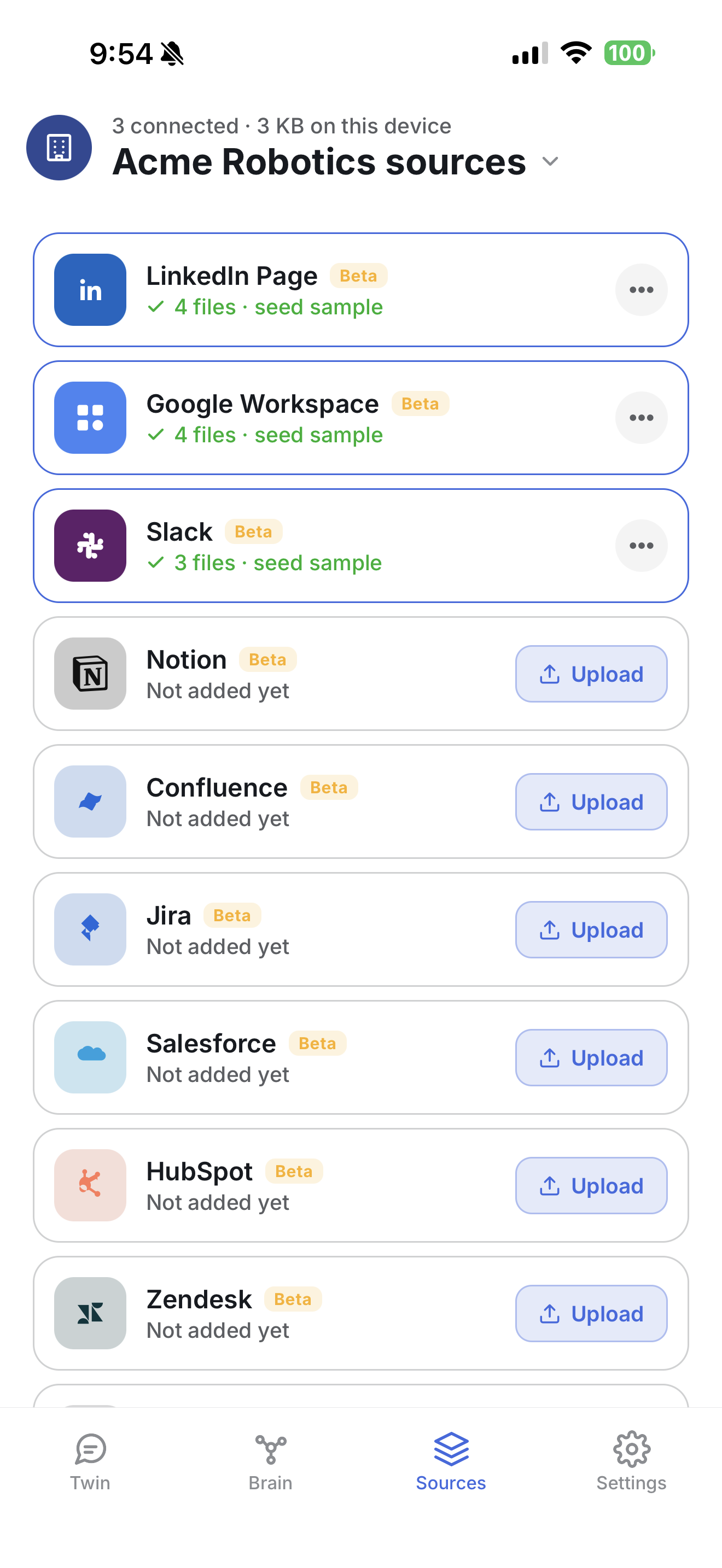
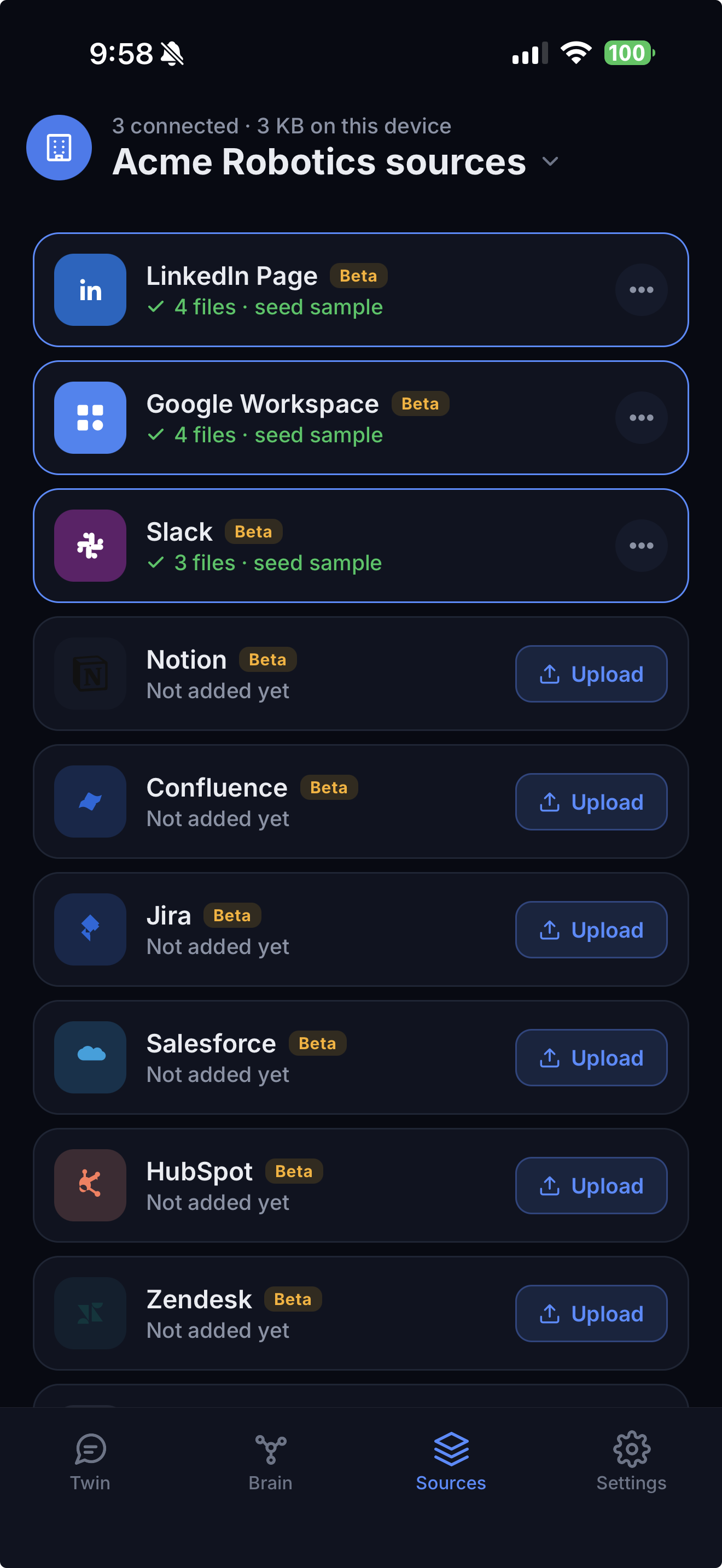
A native mobile app that builds a personal twin entirely on-device — the same zero-network engine that powers the Company Brain. Your people's own exports become their own private brains on their own phones: no account, no backend, nothing touching your infrastructure.
Built on-device
Exports are unpacked and transformed on the phone itself — the brain never exists anywhere else. Meeting prep and warm-path answers from the hallway, not the desk.
The graph in your hand
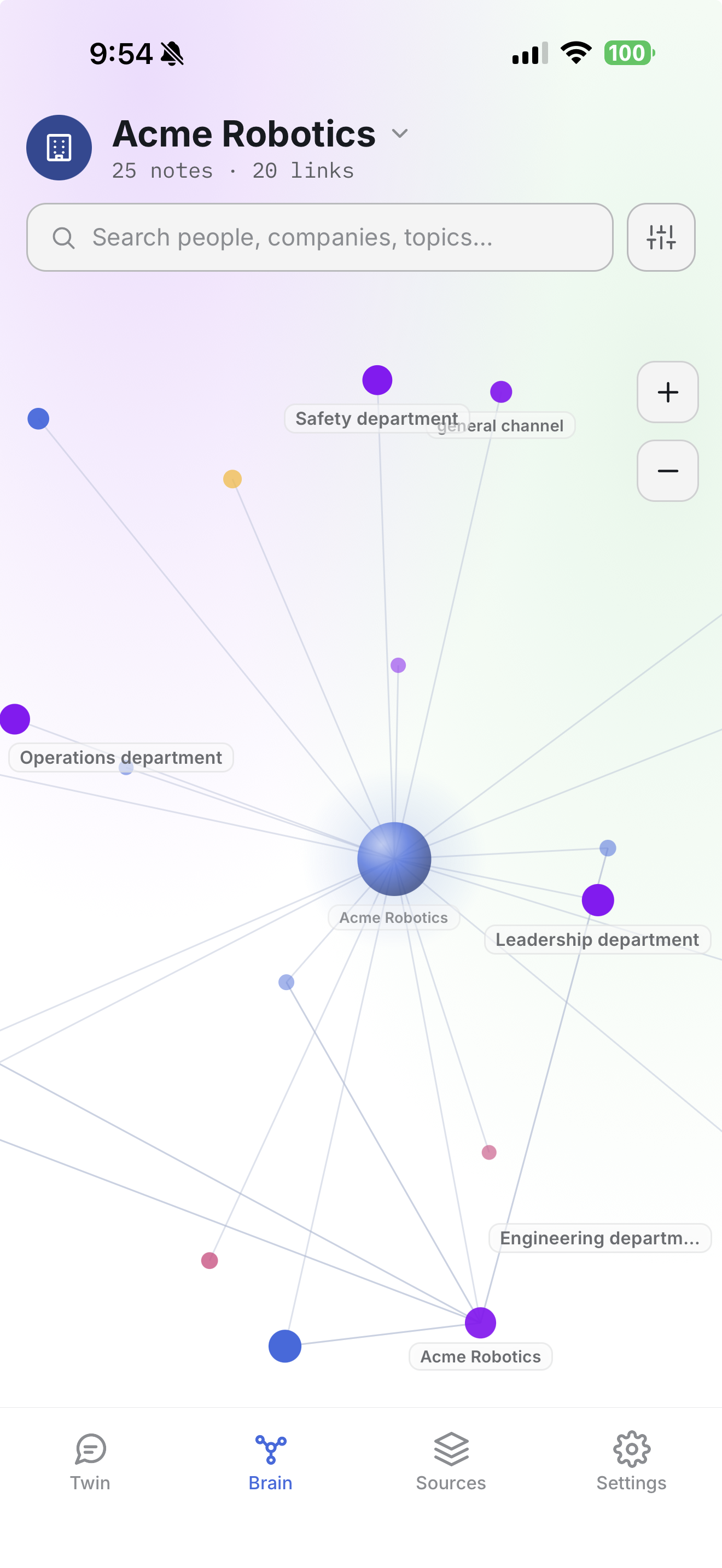
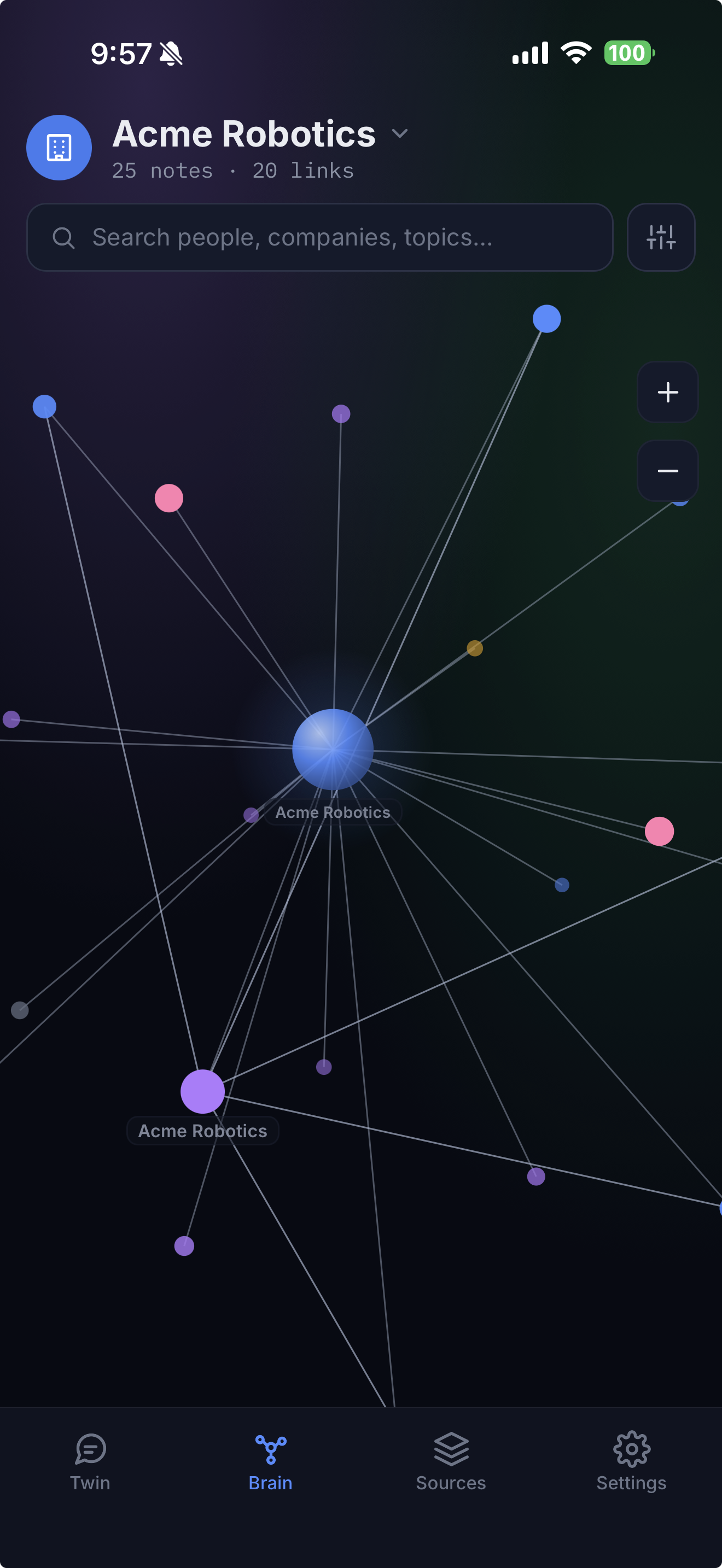
A native 3D graph of people, companies and topics — search it, filter it, tap into any note before you walk into the room.
Private by architecture
No account, no backend, zero telemetry. On-device AI on iPhone; on Android bring your own key — nothing for your security team to threat-model in the cloud.
Live on the App Store and Google Play — free, no account. On-device AI needs a recent iPhone; on Android you bring your own model key.
The problem
Every brain ships empty.
Models are interchangeable and getting cheaper; they are not the constraint any more. What is scarce is context — who is who, what happened, what connects. Today it either sits unindexed in export archives, or it gets rebuilt by hand over weeks. Both are leverage left on the table.
exports/
├── workspace-export.zip       contacts, drive, 4.2 GB
├── slack-export.zip           channels.json, users.json
├── crm-accounts.csv           1,860 rows, stale owners
└── linkedin-company.zip       followers, employees

✕ four silos · same employee 4× · zero links
brain/
├── 00-org/organization.md   org-rooted graph
├── 10-people/
│   └── Dana Reyes.md         1 person · 3 sources
├── 15-organizations/
│   └── Brightline.md         industry, size, sources
├── 40-pipeline/               122 deals
└── _HEALTH.md                  what is still missing

✓ populated, deduplicated, privacy-clean — day one
Institutional memory that survives turnover — the context stays when people move on.
The supply
The law already pried your data loose. Nobody uses it.
Every platform your company runs on is legally compelled to hand you a machine-readable copy of your own data, on request, for free. Getting it out was never the hard part. The hard part is that what comes back is unusable — so it gets downloaded once and never opened again.
Guaranteed by statute
GDPR Article 20, the EU Digital Markets Act and CCPA all mandate portable, machine-readable exports. The raw material is compelled, not negotiated.
It improves on someone else’s budget
Regulators keep widening what must be included and how fast it must arrive. The supply side of this gets better every year without us shipping a line.
Consent is already in the channel
You asked for your own data and the platform handed it over. No scraping, no back-door integration, no terms to argue about.
The most defended data in the business was forced into an open, consented channel — and it lands as an archive nobody can read. That gap is the whole company.
Two doors. One engine.
Your history, or your company’s.
The same problem has two shapes, and one pipeline solves both: detect, resolve, link. A company is simply another subject that deserves a brain of its own.
A brain for you
Built from your own exports — LinkedIn, Google, Facebook, Instagram and more. A digital twin that opens in Obsidian and Claude Code. The personal brain →
A brain for your company
Built from Workspace, Slack, Notion, Jira and CRM archives. Org-rooted, ownership explicit, institutional memory that survives turnover. Bootstrap it →
Or both at once
Hand it a mixed archive and it builds sibling vaults plus a _correlations/ layer linking people across them — who on your team knows whom, and through what.
How it works
Detect. Resolve. Link.
Drop in your export archives. The engine detects each format, resolves the same person across every source — emails and phone numbers stripped in code, never written to disk — and links it all into one typed Markdown graph. Deterministic, about a minute.
- 01
Detect
Point it at a folder of team exports — Workspace, Slack, Notion, Jira, Salesforce, HubSpot, LinkedIn Company… any of the 12 company sources. It catalogs every file, locally — and if your export's format drifts from the known shape, the skill adapts its own mappings to fit it, on your machines.
- 02
Resolve
Every employee, customer, and partner becomes one identity across sources — no more four copies of Dana.
- 03
Build
An org-rooted graph: the company at the center; people, accounts, deals, and projects linked around it. No AI calls.
- 04
Emit
Emit to GBrain for the team, or keep it as an Obsidian vault. Multiple entities get a cross-entity
_correlations/brain.
Identity resolution · the hard part
One employee, three systems, no PII stored.
Dana Reyes is a Slack member, a Workspace account and a CRM record owner — three orphan rows in every other tool. Collapsing them into one identity, on your machines, without ever writing an email address or a phone number to disk, is the engineering that makes the rest possible.
Said precisely: matching is on the normalized name, and it is precision-biased on purpose — a wrong merge is worse than a miss. Variant spellings and initials ("D. Reyes") stay separate rather than quietly fusing two people into one. Sharper matching on secondary signals is roadmap, not shipped.
Built for agents
Not a pile of notes. A typed graph.
Every person, team, account and project is a Markdown note with typed properties and weighted links. An agent does not skim it — it traverses it, and the answer arrives with the notes it stood on. Receipts, not vibes.
Org-rooted graph
The company sits at the center — 00-org — with employees, accounts, deals, and projects as typed, linked notes around it.
Every field carries its source
sources: records which export each note came from. When two exports disagree, both values are kept and attributed rather than averaged away.
Cross-entity correlations
Multiple teams or entities each get a brain, plus a _correlations/ layer linking people ↔ deals ↔ teams across them.
Day-one agent context
Ships with in-brain instructions — point Claude Code or GBrain at it and it knows the schema immediately.
Why you can trust it
An unchecked brain is a confident liar.
Retrieval was never the hard part. Being worth retrieving from is. A graph nobody curates will hand your agent a stale fact with total confidence, and nobody will be able to trace where it came from. So this one is checked.
Every fact keeps its receipt
Each note records which export it came from and when. When your agent answers, it cites the notes it stood on — you can open them and check.
Conflicts are flagged, not averaged
When two sources disagree about a role, an owner or a date, both values are kept and surfaced for a human. Nothing is silently overwritten to look tidy.
Unverified data is quarantined
Anything the engine cannot place goes to _quarantine instead of into the graph, and a coverage report states exactly what was used and what was not.
None of this runs on trust. Every build ends by grading itself — and we publish our own grade below, seams included.
Proof, not polish
The brain shows the gap instead of filling it in.
Every build ends with a _HEALTH.md: orphan notes, unresolved links, snapshot age, duplicate suspicions, open conflicts. Here is the one that ships with our own company demo — unflattering on purpose, because a brain that admits what it is missing is one you can act on.
It counts what is missing
Orphans, unresolved wikilinks and stale sources are listed by name, not summarised away. You can open every one.
Absence beats invention
An account with no people attached says known_contacts: 0. It does not guess a name to look complete.
Why we show ours
A demo that never shows its seams is hiding them. This one is in the repo, in the vault you can download, generated by the same command you would run.
Custody, not promises
Your history is already gathered. Just not by you.
Your company’s history already sits in a dozen systems you cannot search, cannot leave, and do not control. Gathering it here does not create the exposure — it ends it. The core transform makes no network calls, so the question stops being "where does the vendor say this goes?" and becomes "which machine is it on?" Only one of those survives a procurement review.
Physical isolation
The import runs on a laptop, a locked-down server or an air-gapped box. No connection means nothing to intercept — and employee emails and phone numbers are stripped in code at parse time, so they never reach disk in the first place.
Jurisdictional certainty
Residency rules govern where data may travel. Processing offline collapses the boundary from a country to a room. Message bodies are never parsed either — only a frequency and recency signal survives.
HR · payroll · security quarantined
Sensitive exports are skipped by a hard-coded quarantine list — no adapter can bypass it.
You stay the data controller — provably
Everything runs on your infrastructure. MIT-licensed, so your security team can read the rule that enforces it rather than taking our word for it.
Local-first by construction. → Read the privacy model
Said precisely, because vagueness is worthless in a procurement review: the architecture is air-gap-capable today and your team can verify that in the source. The enterprise wrapper around it — SSO, audit trail, private deployment, a compliance pack — is on the roadmap and not shipped. We'll keep saying so until it is.
The Agent Skill · Claude Code & OpenAI Codex
The engine itself — install it, then just ask.
The product that powers everything: the open-source engine, packaged as a cross-model Agent Skill. Install it once in Claude Code or OpenAI Codex and your agent knows how to turn export archives into a structured, deduplicated, privacy-clean Company Brain — on your infrastructure, with zero network calls.
Runs where your data must stay
On a laptop, an air-gapped box, or your own server — dependency-free Python, zero network calls in the core. Nothing for security to threat-model in the cloud.
Self-adapting to your exports
Formats drift across tools and versions. The skill profiles every file, writes its own mapping rules, and rescues what it doesn't recognize — nothing is lost.
Emits your format
Obsidian vault by default, GBrain repo on request — plain Markdown either way, owned by you, readable by any agent.
The same skill powers Studio's reseed and the done-for-you onboarding — install it in one step or browse the source on GitHub.
Works with GBrain
Feed your GBrain from the archives you already own.
GBrain is the brain layer — search, synthesis, team serving. We're the importer that fills it on day one, from your fragmented exports, identity-resolved and privacy-clean.
Not affiliated with the GBrain project. We emit the open-source GBrain format — we're the importer; GBrain is the brain.
What your brain can do
Give your brain a goal.
Get started
Bootstrap your Company Brain.
Where this goes
Models depreciate. Your graph compounds.
Every quarter the models get cheaper and more alike. Whatever you can rent, your competitor can rent. The part of your stack that appreciates is the part nobody else has: the record of what you have done, who you know, what you decided and why.
That record already exists — scattered across a dozen systems, exportable by law, doing nothing. We turn it into an asset: one identity-resolved graph, in plain Markdown, on a machine you control. Every new model release makes that graph worth more, because a better reasoner over the same context beats the same reasoner over none — and you rebuild nothing to collect it.
The endgame is not one system that knows everyone. It is millions of private brains — one per person, one per company — interoperable because they are plain files, owned because they were built that way. Ownership cannot be retrofitted after your history is in someone else’s database. It has to be the starting condition. That is why the engine is MIT, local, and free.
- I
Fill it
Every brain ships empty. We fill it from the archives you already own — 25 sources, identity-resolved, in about a minute. Shipped.
- II
Trust it
A brain nobody checks is a confident liar. Provenance on every fact, conflicts flagged rather than averaged, the rest quarantined. Health reporting ships today; the review queue is next.
- III
Run it
The brain stops being something you read and becomes something that works: one-page procedures it can run unattended and hand back a briefing. Not shipped — this is v2.
- IV
Keep it
Plain Markdown on your disk, MIT, no lock-in — it stays yours across jobs, tools and vendors. Local re-import ships today; hosted sync is the paid layer.
LinkedIn → vault
Full local transform, Obsidian-native.
Multi-source
One identity-resolved graph across many archives.
Cross-model + company
Claude + Codex, per-entity brains, GBrain emitter, JSON mappings.
25 sources
13 personal and 12 company sources; --refresh updates in place.
Always-fresh
--refresh re-import shipped: update from a newer archive, your edits kept. Hosted scheduled sync lands with Cloud.
Anatomy & activation
Cellular graph anatomy and spreading-activation retrieval, animated on real numbers. 25k-note vaults render fully.
The agentic ops layer
The brain that acts: meeting prep, drafting in your voice, reviving dormant relationships — and research that starts from your own context.
Local OSS core free forever. Done-for-you onboarding and hosted sync are how it becomes a company.
Start tonight
You own the archive. Now own the brain.
Request your exports, point the engine at the archives, and in about a minute you have a graph your agents can use. Free, MIT, entirely on your machines — or we can onboard your company’s brain for you. (Early access.)
Local-first · MIT · you're the data controller · emits to GBrain.